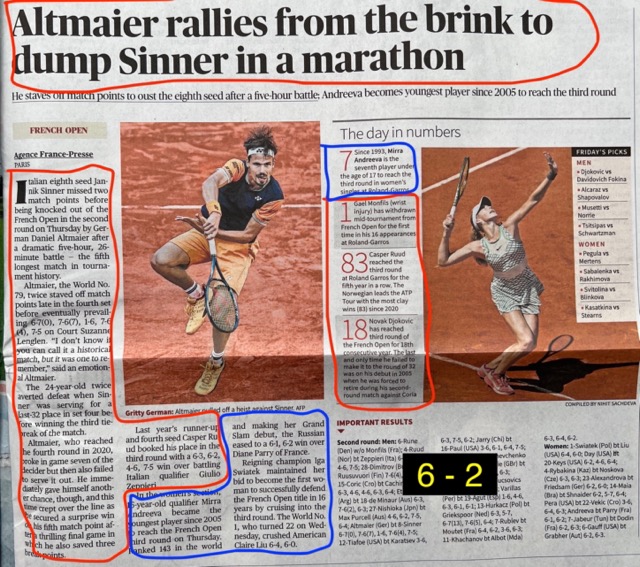
The French Open 2023 concluded yesterday, and throughout the tournament I kept track of how my newspaper – The Hindu – covered the men’s game vs. the women’s game in their sports pages. They sourced their main articles from Agence France Presse, and there was a separate “Day in Numbers” section by someone from The Hindu.
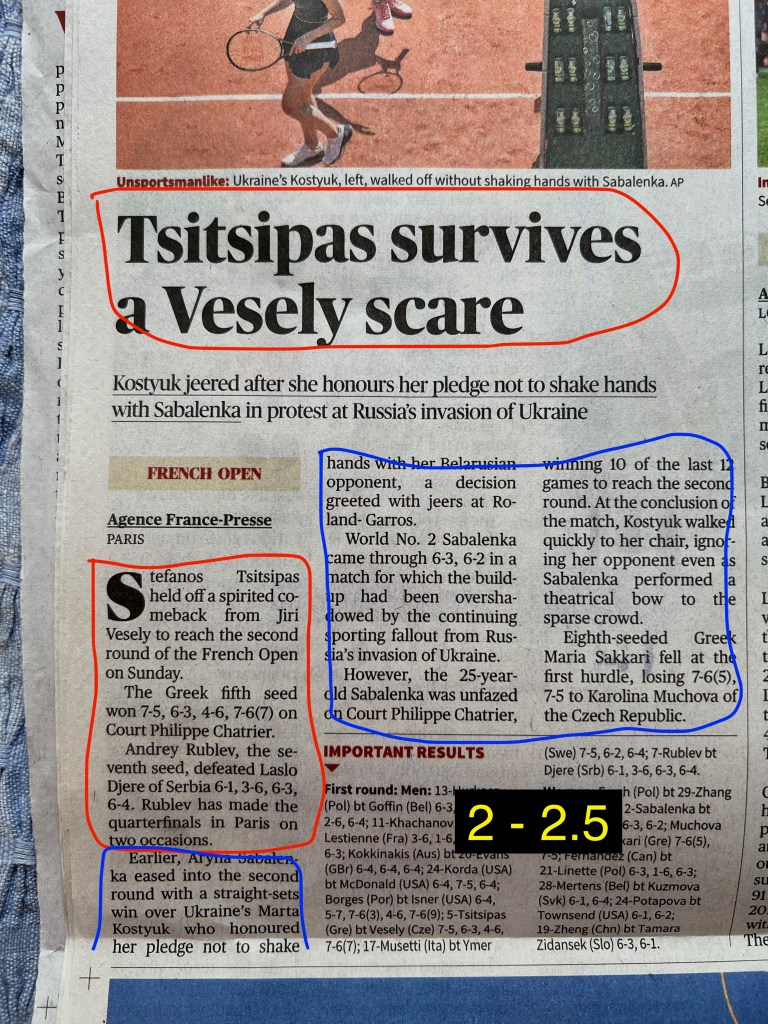
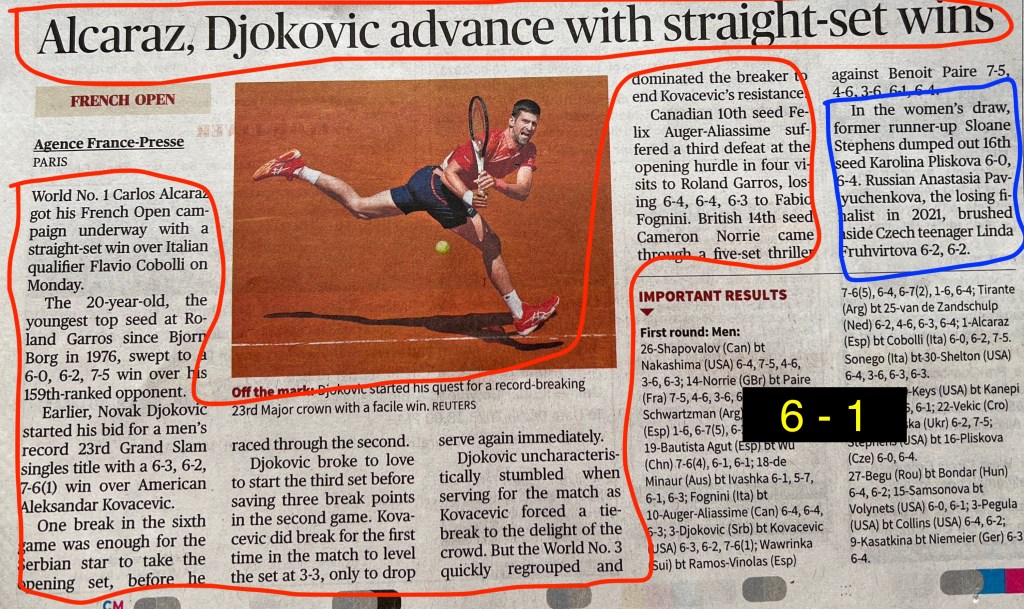
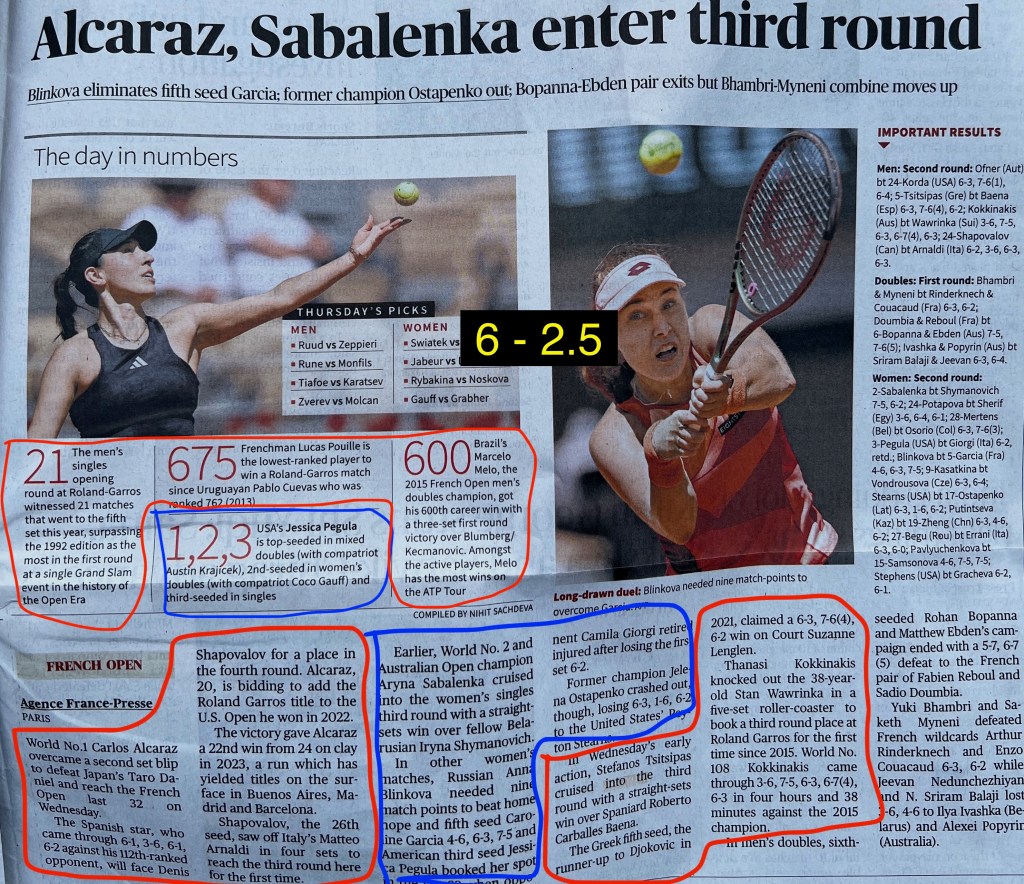
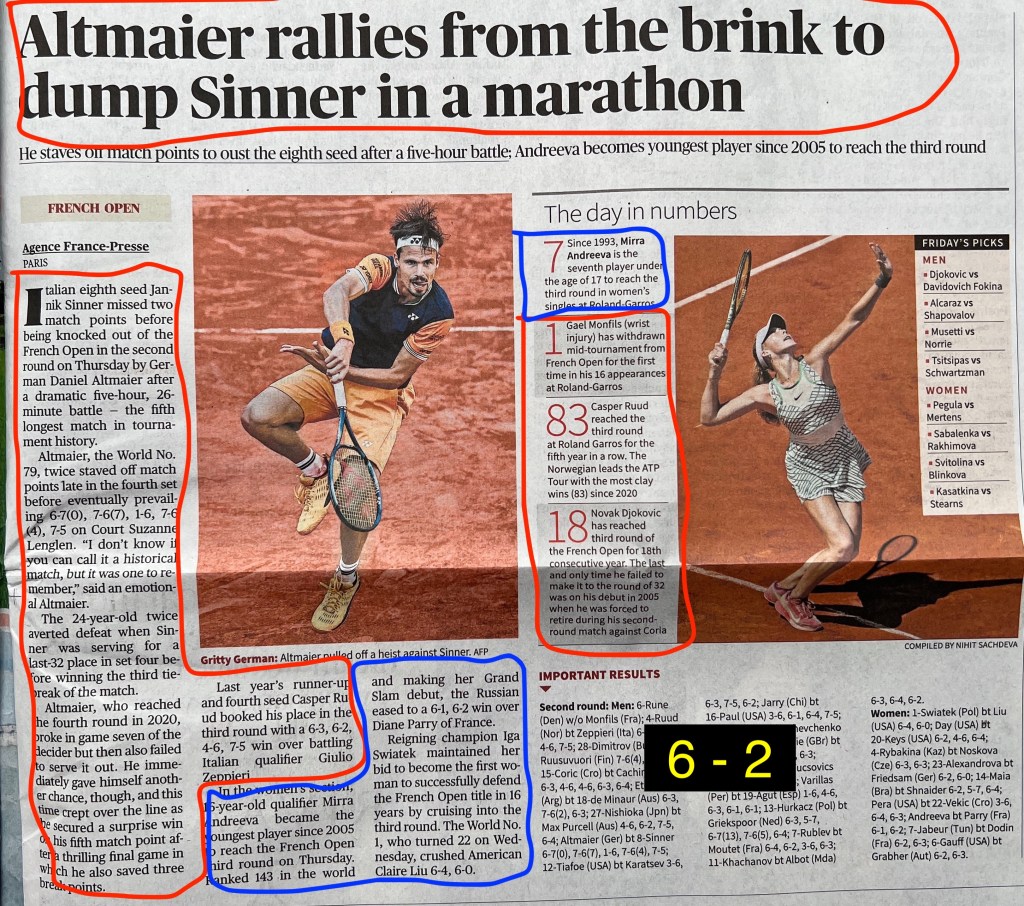
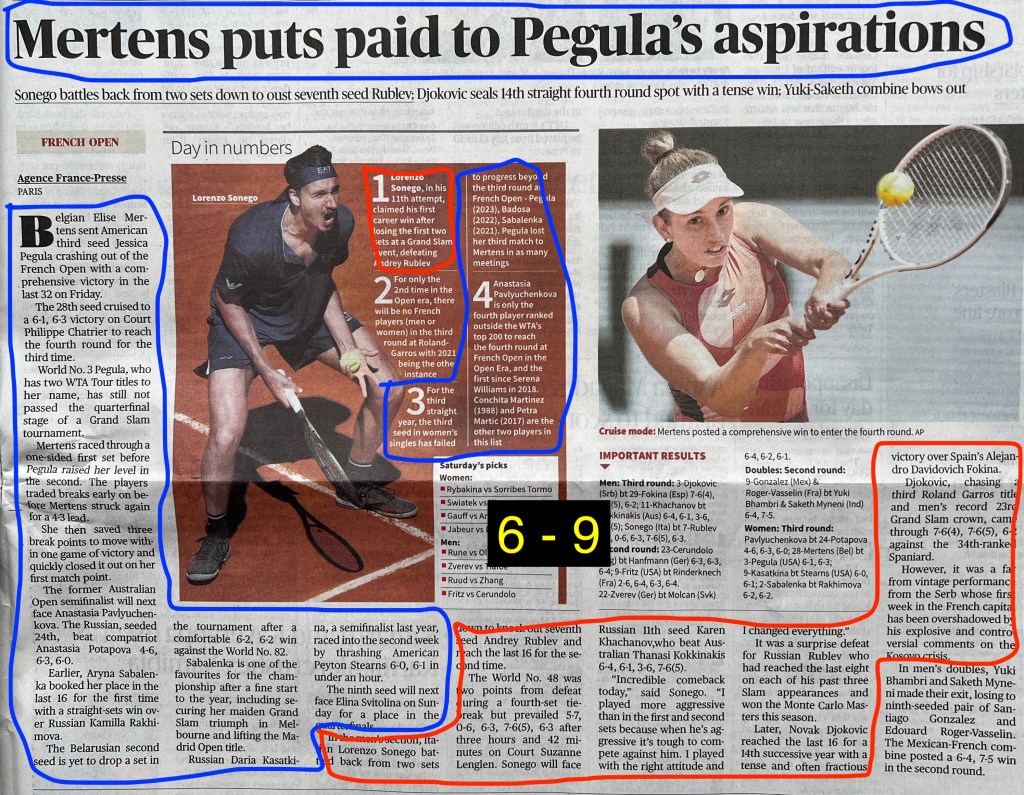
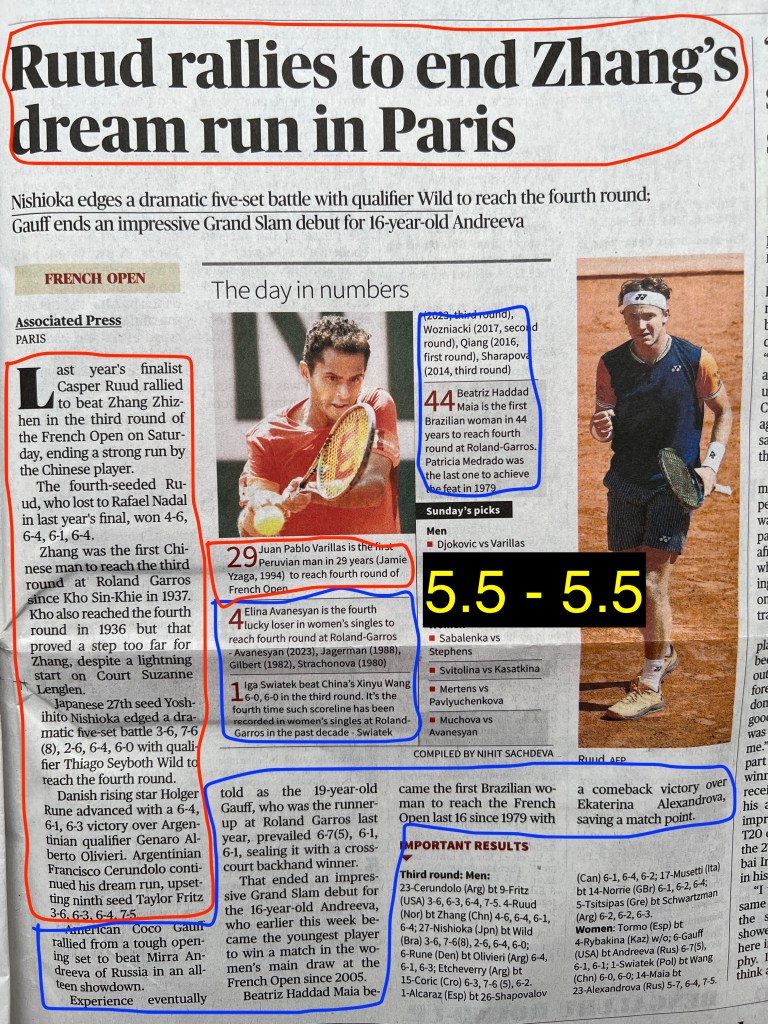
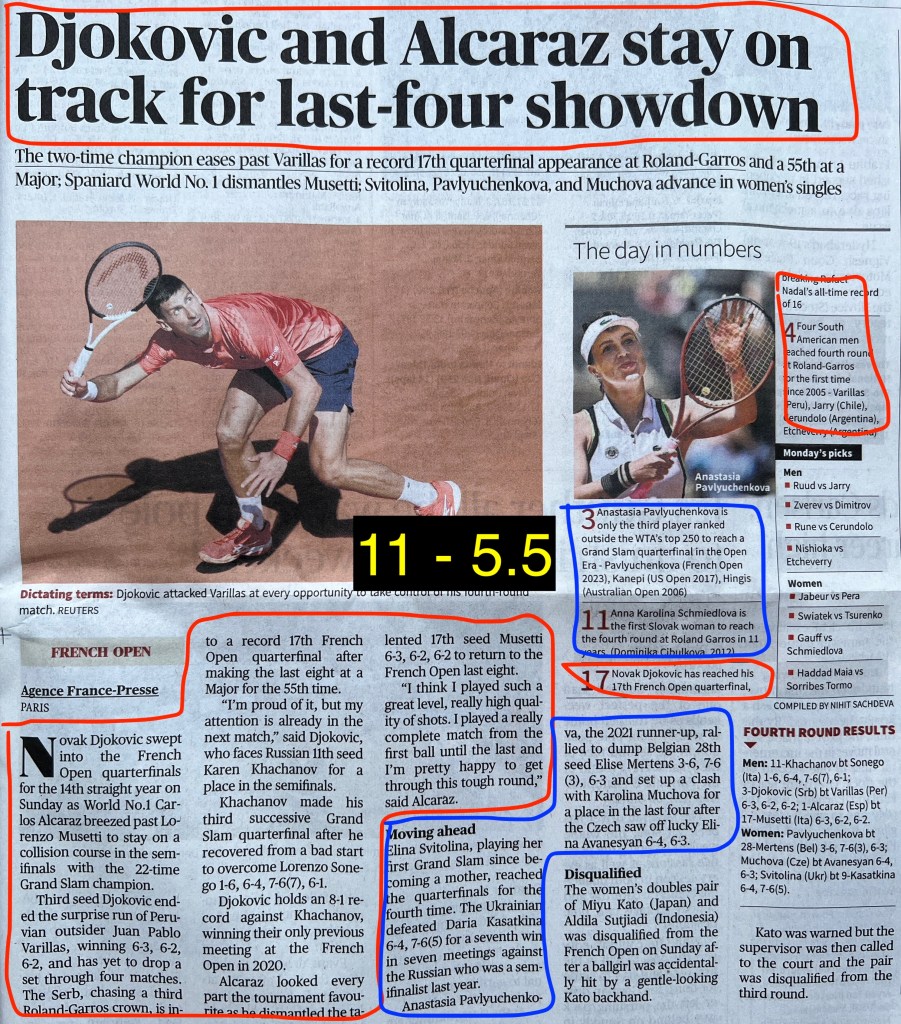
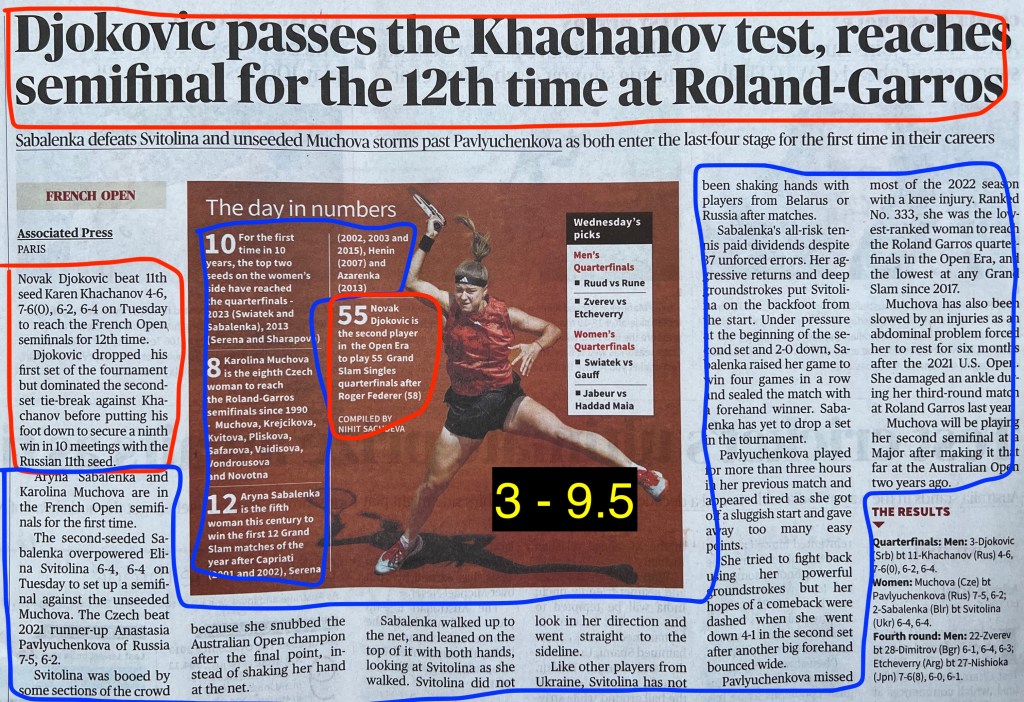
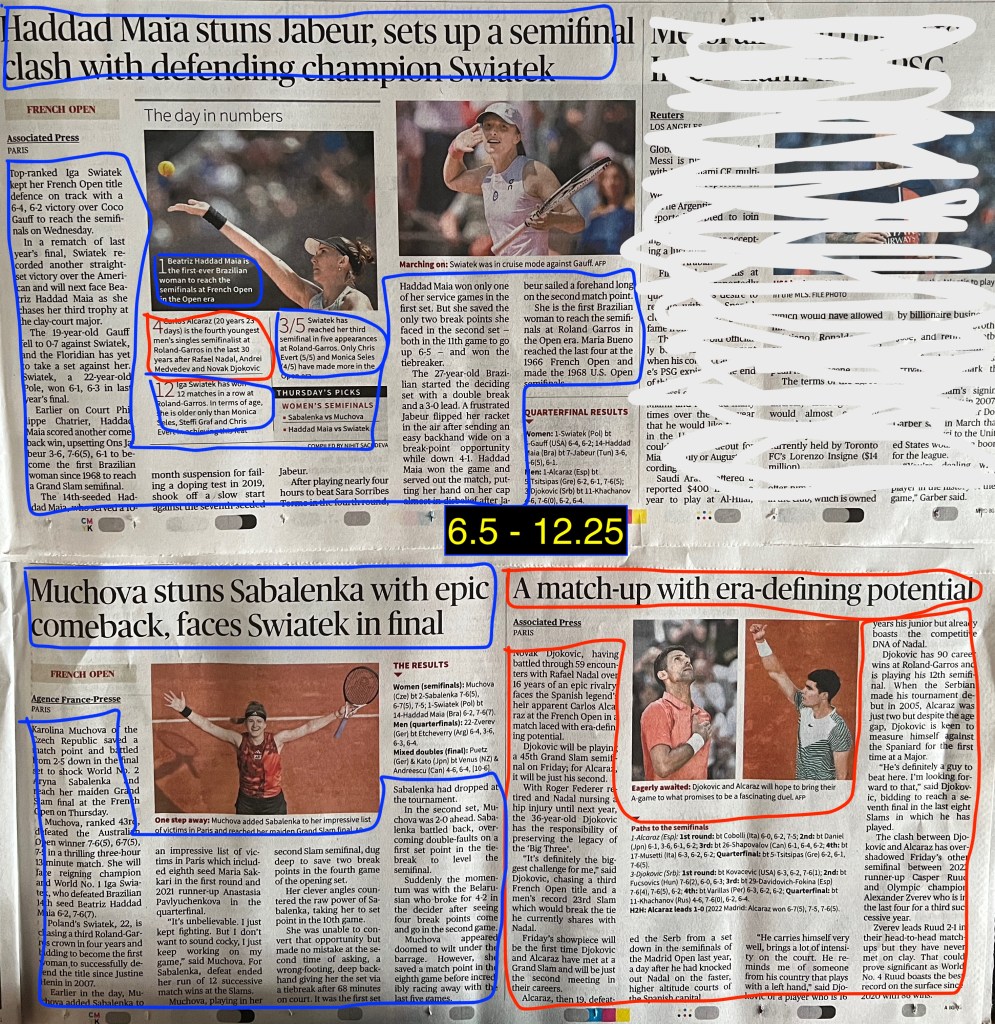
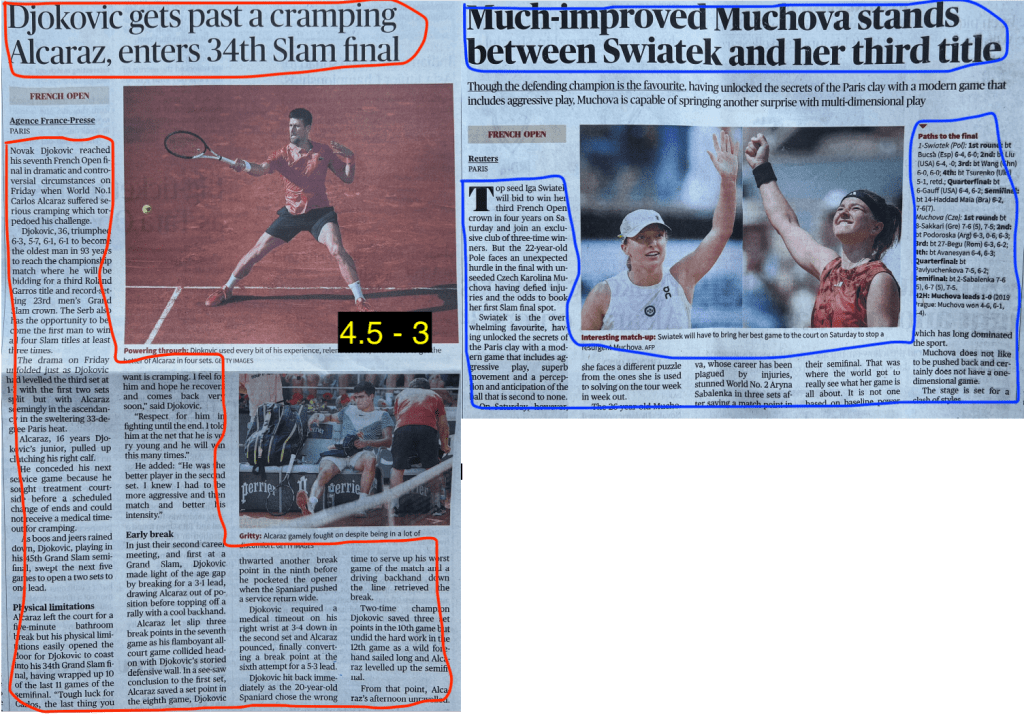
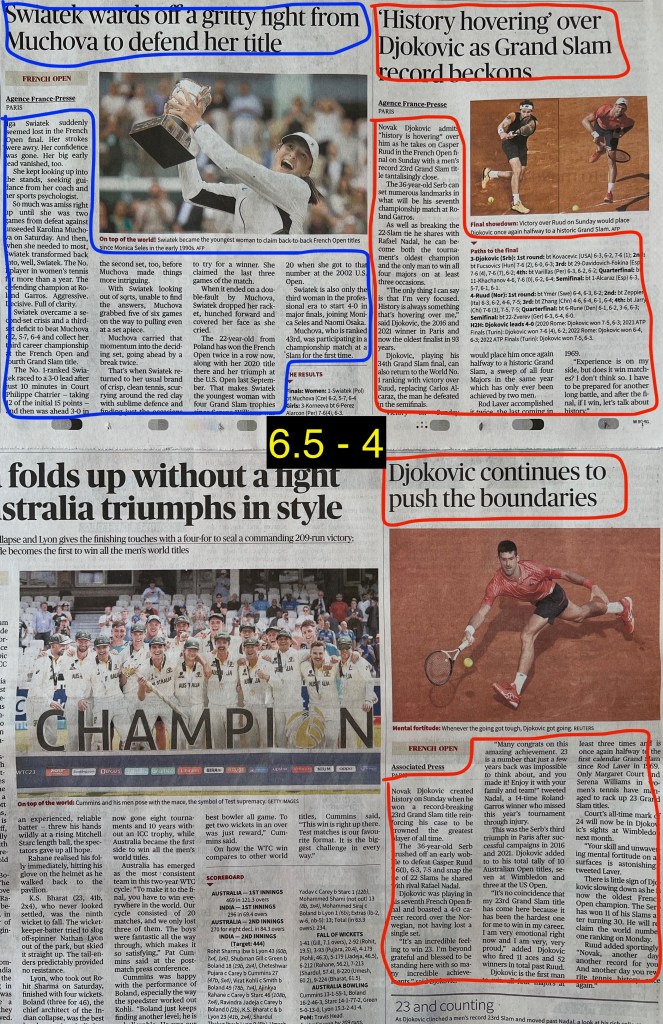
This is how I kept score: I added up points for column space roughly by height; a point for a headline, and a point for each “Day in Numbers” item. (I deliberately avoided photos, because photos of female athletes are something male journalists seem to have no problem publishing.) I belatedly realised I should have measured column height on paper rather than the photo, to keep the scale consistent across days – I’ll do that next time if this becomes a series.
Findings
Overall, 54% of the coverage was of the men. This is pretty good – I expected a lot worse. The first week was 62% men, but the second week saw relatively higher coverage for women at 56%.

There were 11 men-only headlines, and only 5 women-only headlines.
There were 11 quotes from men, and only 2 from women.
“The Day in Numbers” had 17 picks for men, and 19 for women.
A trope I’ve been noticing for decades (I’m of Edberg/Seles vintage), is where the writer will denigrate and emphasize negatives for a women’s match but not for a men’s match. I noticed a few cases this time. Ostapenko’s final-set loss is described as “crashing out”; world number 3 Pegula “has not passed the quarter final stage of a grand slam”; Pavlyuchenkova winning a final set 6-0 is meh, but Nishioka doing the same is a “dramatic battle”; a match is described as “long-drawn”; Blinkova “needed 9 match points to win” – you’d be surprised to know that was a 7-5 final set against a fifth seed.
Here’s the “data”:


Frequently Raised Objections (FROs) to Women’s Tennis
1. “Less coverage of women isn’t sexist, it just reflects what people are interested in.”
Sexism is both conscious and unconscious. In a patriarchal society which influences our minds from the day we’re born, it would be very surprising if we weren’t less interested in women’s tennis. We value whatever men do more. I’ve talked at length about this “value gap” in my Year of Grand Slam Data post, so I won’t repeat that here. If journalists, editors and sports fans haven’t had feminist consciousness-raising, they will prefer men’s tennis. So to say that “this is just people’s interests” is merely a restatement of the problem.
2. “It’s just like doubles.“
An extension of #1 above, this is an argument from analogy that goes like this: “People aren’t that interested in doubles, hence it does not get as much media coverage as singles. Similarly, people aren’t that interested in women’s tennis, so that’s why it does not get as much media coverage.”
As with any analysis of an argument from analogy, we look for any significant and relevant differences between the two objects: in this case, doubles tennis and women’s tennis. I trust you can see there is no patriarchy-equivalent social system that oppresses doubles players.
3. “Five sets vs. three sets”
I’ve covered this in my Year of Grand Slam Data post: in short, the women are willing to play five sets but the ITF has a problem with it; also there is a case for tennis scoring to be revamped the way other sports like badminton have done.
4. “Women’s tennis is full of unforced errors/[some other thing].”
This too is covered in my Year of Grand Slam Data post. I can’t find the same kind of aggregated data any more to do a comparison – it looks like the grand slams stopped publishing them. It’s worth keeping in mind how sexism might make us see things that aren’t there, like my “full of unforced errors” acquaintance in that post who turned out to be wrong. (You’ll be surprised to find that even Djokovic and Alcaraz had matches in this very tournament with more unforced errors than winners.) It’s very hard to tell without hard data. In any case, tennis like most sports was made by men for men; men have a natural advantage; so it’s senseless to expect or demand women’s tennis to be just like men’s tennis.
Next stop: Wimbledon 2023.
 Sunil D'Monte
You must be logged in to post a comment.