Since the 2013 US Open (this post was originally written in 2014), I’ve been collecting the statistics published by the grand slam tennis tournaments in a spreadsheet. This was prompted by a discussion on sexism in tennis about a year ago, where I saw someone say he didn’t watch women’s tennis these days as it was “full of unforced errors”. So I decided to have a look at what the stats were. And since they publish stats not only on unforced errors but many other measures as well, and they use an identical tabular format (links: Aus, French, Wim, US), it was easy to compare and aggregate them.
I chose a number of “metrics”, some I’m sure most tennis fans will agree on, some based on what I like in tennis. I also did a per-game/per-set normalisation to get around the 3-set/5-set difference (more on the number-of-sets issue later). Here are the metrics I chose:
(1) Winners per game (the more the better), (2) winners rate (the more the better), (3) unforced errors per game (the lower the better), (4) unforced errors rate (the lower the better), (5) winners to unforced errors ratio (the more the better), (6) points per game (the more the better), (7) games per set (the more the better), (8) %age of straight-sets matches (the lower the better), (9) %age of final-set matches (the more the better), (10) %age of tie-break sets (the more the better), (11) double-faults per game (the lower the better), (12) service breaks rate (the more the better).
Before looking at the data, try to do a estimate in your mind of what you think these numbers will be like.
The Data
Here are the results: you can view the Google spreadsheet here (hopefully the Excel-to-Google conversion preserved all the formulas), or you can simply see the aggregates in the screenshot below (click to enlarge):
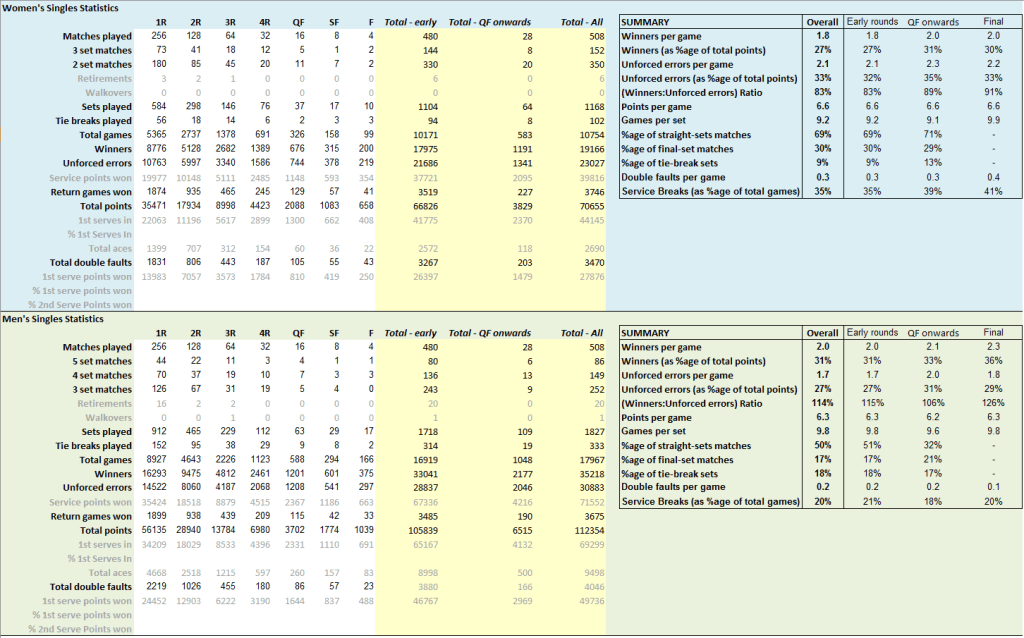
The results (aggregate of all 4 tournaments):
(1) Winners per game: men 2.0, women 1.8
(2) Winners rate (as % of total points): men 31%, women 27%
(3) Unforced errors per game: men 1.7, women 2.1
(4) Unforced errors rate (as % of total points): men 27%, women 33%
(5) Winners to unforced errors ratio: men 1.14, women 0.83
(6) Points per game: women 6.6, men 6.3
(7) Games per set: men 9.8, women 9.2
(8) %age of straight-sets matches: men 50%, women 69%
(9) %age of final-set matches: women 30%, men 17%
(10) %age of tie-break sets: men 18%, women 9%
(11) Double-faults per game: men 0.2, women 0.3
(12) Service breaks rate (as % of total games): women 35%, men 20%
Arguments
Arguments that women should receive less prize money than men are more generally arguments about value – i.e. does men’s tennis have more value than women’s tennis. The measurement of this value can take many forms – prize money is one of them; other forms are things like the amount and nature of media coverage, and the amount and nature of public appreciation. The higher the prize money, and the more and better the media coverage and public appreciation, the more the tennis is valued.
Most commonly one hears the argument that since men play best-of-5 and women play best-of-3, therefore men’s tennis deserves more prize money (i.e. it has more value). Leaving alone the fact that the WTA is willing to play best-of-5 too (links: Major obstacle to women’s call for five sets, WTA chief says women ‘ready, willing’ for five sets), the main flaw in these arguments is inconsistency – if number of sets really determines value, then that metric ought to be applied uniformly across the board rather than only on two sides of an arbitrarily chosen divide of men’s tennis and women’s tennis – i.e. it ought to be applied to all tennis matches, period. So a man who loses in 3 straight sets should receive less prize money (and less and worse media coverage and public appreciation) than a man who loses in 5 sets – because going by the logic of that particular metric, there is a difference in value the two men have provided. The same principle holds for any of the metrics above, or any other metric of your choosing, such as market demand (ticket sales, TV ratings etc.). Today the prize money is already equal, so what of the other measures of value – the media coverage and the public appreciation? It’s quite easy to see the inconsistency – a men’s match is treated kindly even when it ought not to be (as per these metrics). The media tends to be generous with praise and emphasizes the positive rather than the negative, with far more interview quotes and coverage for the men in general. One example from recent times – Maria Sharapova’s final-set defeat to Angelique Kerber in this year’s Wimbledon only got one sentence of coverage in The Hindu. Yet it devoted several paragraphs to Andy Murray’s straight-sets defeat (on a different day) – and this discrepancy in coverage was repeated on many days. This issue is something that would be worth doing a proper study on.
The fact that nobody is demanding “variable value” based on such metrics, yet noises about men-vs-women keep being made, indicates just how deeply embedded gendered thinking is – the divide shows up artificially even when it isn’t relevant, all the while appearing to be perfectly natural. (If you did make this proposal there would be an outcry against it, from players and fans alike – particularly if it involves prize money. I think the reason goes back to Michael Sandel’s Moral Limits of Markets. Market evaluations and incentives have a degrading and corrupting effect on certain goods and practices, and sports is one of them. Sports is bound up in all kinds of human emotion and values – honour, courage, beauty, skill, triumph over adversity – perhaps that’s why we wouldn’t like this idea. It also explains why we get angry when players aren’t loyal to their teams and play for the highest bidder.)
Another thing worth noting is, it’s debatable whether the 5-set format is better. It results in less straight-sets matches, but it also results in less final-set matches than the best-of-3 format. Yet you don’t see anyone arguing, “Women play more final-set matches, so women should receive more prize money”. Which leads me to to think that reason “5 sets” is used in the argument is that it’s what men play. Personally, I find a three-straight-sets match even worse than a two-straight-sets match, because the loser had three opportunities to win a set – over two-plus hours of my life which I’m never going to get back – and he couldn’t do it. A final set is the only thing I’m willing to watch in a tennis match these days, unless I have an emotional investment in one of the players. So I think the tennis authorities should instead revamp the scoring system entirely – neither best-of-3 nor best-of-5, but something completely different. Games like badminton, volleyball, squash and table-tennis have all experimented with scoring changes to make the game more appealing, so it’s worth trying. There will be objections to it, but I suspect these objections will mostly be a case of status-quo bias.
Finally, all the above is even before you take into account other important premises that ought to be included in any argument about men’s tennis and women’s tennis: the biological advantage that men have, and the barriers of sexism that women face and men don’t: implicit bias, explicit bias, objectification, sexualisation, infantilisation, body shaming, and policing of “femininity”. So taking all this into account, I conclude that we ought to value men’s tennis and women’s tennis equally, and also that the tennis authorities should look into changing the scoring system to make the game more appealing.
—
PS: any errors you find in the spreadsheet are honest mistakes; please point them out if you find any. I got tired of validating the data and the formulas and was seeing stars by the end of it, so I’m just going to go ahead and publish this post now.
 Sunil D'Monte
You must be logged in to post a comment.